 Skip to content

By the Arclight Dynamics team · Updated November 3, 2026 · 9 min read
Quick Answer: Should Your Shop Buy a Plasma Table or a Fiber Laser?
It comes down to material thickness and budget. A fiber laser wins on thin sheet: faster, a narrower kerf, tighter tolerances, crisper small holes and almost no dross. A CNC plasma table wins on plate. It pierces ½" to 1¼" mild steel on Hypertherm Powermax and MAXPRO systems and handles plate up to 3" on the Arc Max Unlimited, for a fraction of the purchase price: Arclight tables start at $13,995, and the Piranha fiber lasers Arclight also sells start at $134,900. If your daily work is thin sheet in volume and your customers pay for tight tolerances, look at a fiber laser. If it’s ¼" and up, mixed thicknesses, or you need to start cutting on a small-shop budget, buy the plasma table. Arclight sells both, so you get an honest answer either way.
In This Guide
How Does Plasma Cutting Compare to Fiber Laser Cutting?
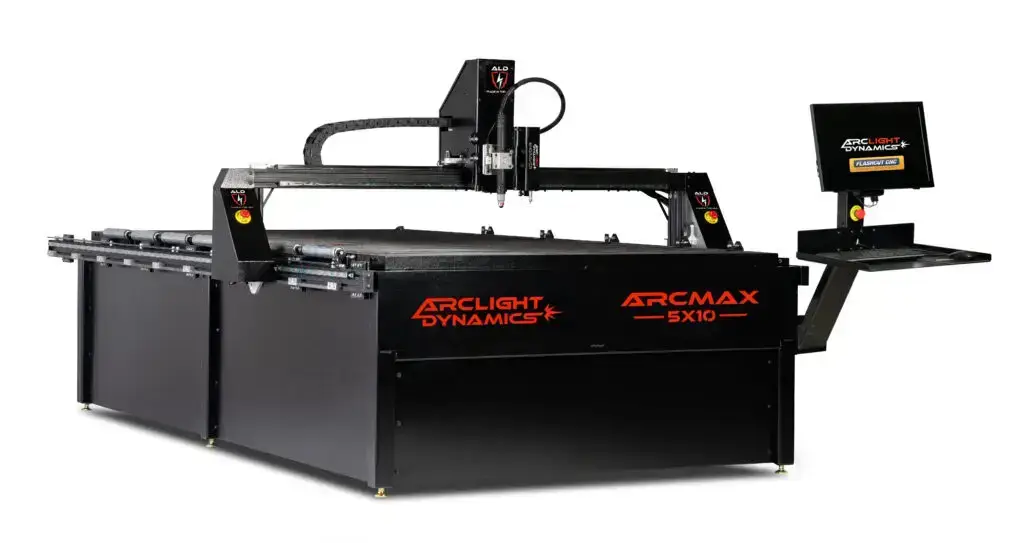
Plasma cuts with an electric arc forced through a narrow nozzle by compressed gas. The arc melts the metal and the gas blows it out of the cut. It’s forgiving, fast on plate, and the equipment is relatively simple: a table, a plasma power supply, compressed air and a water pan.
A fiber laser cuts with a focused beam of light from a solid-state resonator. The beam is far narrower than a plasma arc, so the kerf is thinner, the heat-affected zone is smaller and fine detail comes out sharper. That precision takes more machine: a fiber resonator, a chiller, a dust removal system and assist gas.
| CNC plasma table | Fiber laser | |
|---|---|---|
| Sweet spot | Plate and mixed thicknesses | Thin sheet in volume |
| Thickness | Pierce ½"–1¼" on Hypertherm Powermax and MAXPRO systems; up to 3" plate on the Arc Max Unlimited | Depends on resonator power: see the Piranha spec for the model |
| Edge and detail | Clean, production-ready edge; HD plasma for finished edges on plate | Narrower kerf, tighter tolerances, sharper small holes |
| Materials | Any conductive metal | Steel, stainless, aluminum and other sheet metals |
| Purchase price | Arclight tables from $13,995 (table) to $182,995 (Arc Max X HD system) | Piranha fiber lasers from $134,900 |
| Power | Table on a dedicated 120V circuit; plasma cutter single or three phase by model | Set by the model spec; plan it with the quote |
| Footprint and setup | Open table with water pan; ships 98% assembled | Laser bed with chiller and dust removal system |
| Operating consumables | Nozzles, electrodes, shields; compressed air | Nozzles and protective lenses; assist gas and electricity for the resonator and chiller |
Arclight table prices as of November 2026; Piranha fiber laser starting prices as listed on arclightcnc.com.
When Is a Fiber Laser the Right Choice Over a Plasma Table?
A fiber laser earns its price on thin sheet, in volume, to tight tolerances: enclosures, brackets with small holes and slots, HVAC and sheet-metal parts, stainless and aluminum panels, and anything where the cut edge is the finished edge. On that work a fiber laser runs faster, needs less secondary finishing and holds dimensions part after part.
Arclight sells the Piranha fiber laser line: the compact SP404 (a 4′×4′ footprint, 3 or 6 kW, from $134,900), the single-pallet SP510 for full 5×10 sheets (from $173,900), and the FLEX510 from 3 kW to 20 kW (from $282,900). The SP510 ships with the fiber resonator, a chiller, Cypcut control software and segmented downdraft dust removal, and every Piranha laser comes with lifetime support and real application support from people you can talk to.

When Is a CNC Plasma Table the Right Choice Over a Fiber Laser?
A CNC plasma table is the right call when your work runs to plate, structural parts and mixed thicknesses. That covers most fabrication shops, farm and equipment repair shops, and anyone else who cuts plate for a living. One table cuts everything from sheet to heavy plate, runs on a dedicated 120V circuit with the plasma cutter matched to your shop’s power, and costs a fraction of a laser to buy and set up.
Match the Arclight table to the plate you cut every week. The Arc Pro Ultra V3 handles sheet and light plate from $13,995. The Arc Max Elite is the production table for ½" and up every day, and the Arc Max Unlimited takes plate up to 3" with MAXPRO200 or oxy-fuel. When edge quality on plate matters, the Arc Max X with Hypertherm® XPR plasma gives you true HD cutting. Our thickness guide has the pierce and cut ratings by system.
What Does a Plasma Table Cost Compared to a Fiber Laser?
Purchase price is the biggest single difference between the two, and the gap is wide.
| Setup | Example | Price |
|---|---|---|
| Entry plasma system | Arc Pro Ultra V3 4×8 + Hypertherm Powermax45 SYNC | $20,770 |
| Production plasma system | Arc Max Elite 5×10 + Powermax85 SYNC | $42,545 |
| HD plasma system | Arc Max X 5×10 with Hypertherm XPR170 (complete system) | $160,995 |
| Compact fiber laser | Piranha SP404 3 kW | from $134,900 |
| Full-sheet fiber laser | Piranha SP510 3 kW | from $173,900 |
| Production fiber laser | Piranha FLEX510 (3–20 kW) | from $282,900 |
List prices as of November 2026. Plasma cutter prices are the configurator prices on our product pages. Freight, air or assist-gas systems and installation are quoted separately.
Running costs differ in kind as well as amount. A plasma table burns nozzles and electrodes and needs clean, dry compressed air. A fiber laser draws power for the resonator and chiller, uses assist gas, and wears nozzles and protective lenses. The honest comparison is cost per good part on your work. Send us a few drawings and we’ll quote both. Full plasma pricing is in our CNC plasma table cost guide, and financing is available on either machine.
Can One Fabrication Shop Justify Both a Plasma Table and a Fiber Laser?
Yes, and many growing shops end up with both. They usually buy in the same order: plasma first, laser second. The plasma table pays for itself on plate and structural work and builds your customer base. Once thin-sheet work grows to where secondary finishing and tolerance rework are eating margin, a fiber laser takes that work over and the plasma table goes back to what it does best.
Buying both from Arclight means one relationship: lifetime tech support that follows the plasma table, U.S.-based service and application support on the laser, and one sales team that will tell you honestly which work belongs on which machine.
Plasma or Fiber Laser: How Do You Decide?
Answer these five questions and the choice usually makes itself.
- What’s the thickest material you cut every week? If it’s regularly ¼" and up, start with plasma.
- What tolerance do your customers actually pay for? If parts go to welding or paint, plasma holds it. If the cut edge is the finished edge on thin sheet, a fiber laser earns its keep.
- How many parts a day? High-volume thin-sheet production favors a laser. Job-shop variety favors plasma.
- What power and floor space do you have? A plasma table needs a dedicated 120V circuit, a plasma cutter matched to your shop’s power, and room for the table. A fiber laser’s electrical service, chiller and dust removal come from the model spec, so plan the space and power with the quote.
- What’s the budget, including financing? A complete plasma system starts around $20,000. A fiber laser starts around $135,000.
If you’re still torn, tell us what you cut and we’ll quote the machine that fits: plasma, laser or both.

Plasma vs Fiber Laser: Frequently Asked Questions
Is plasma or laser cutting better?
Neither one wins every job. A fiber laser is better on thin sheet where tight tolerances and a finished edge matter. A CNC plasma table is better on plate, mixed thicknesses and tight budgets, and it costs a fraction of a laser to buy.
Which costs less, a plasma table or a fiber laser?
A plasma table, by a wide margin. Arclight CNC plasma tables start at $13,995 and a complete entry system with a Powermax45 SYNC is $20,770. The Piranha fiber lasers Arclight sells start at $134,900.
How thick can a fiber laser cut compared to plasma?
Fiber laser thickness depends on resonator power, so check the spec for the specific model. On air plasma, a Powermax45 pierces 1/2-inch mild steel and a MAXPRO200 pierces 1-1/4 inches, and the Arc Max Unlimited handles plate up to 3 inches.
Can a plasma table cut aluminum and stainless?
Yes. A CNC plasma table cuts any conductive metal, including aluminum and stainless steel. For finished stainless and aluminum edges on plate, the Arc Max X with Hypertherm XPR high-definition plasma gives you HD cutting.
Does a fiber laser need special power or ventilation?
Plan for it. A fiber laser’s electrical service, chiller and dust removal are set by the model, so confirm them from the spec before you buy. The Piranha SP510, for example, ships with a chiller and a segmented downdraft dust removal system. A CNC plasma table runs on a dedicated 120V circuit, the plasma cutter is matched to your shop’s single- or three-phase power, and the water pan helps control smoke.
Does Arclight sell fiber lasers?
Yes. Arclight sells the Piranha fiber laser line: the SP404, SP510 and FLEX510, from 3 kW to 20 kW, backed by U.S.-based service.
Keep Researching
- Choosing a CNC Plasma Table: The Complete Buyer’s Guide: the deep spec reference for plasma tables
- What Can a CNC Plasma Table Cut?: pierce and cut capacity by material and system
- How Much Does a CNC Plasma Table Cost?: 2026 prices for every series
- What Plasma Cutter Do You Need for a CNC Table?: match Hypertherm amperage to the plate you cut
- Piranha fiber lasers: the SP404, SP510 and FLEX510 lines
Plasma, Laser or Both: Get an Honest Answer and a Quote
Send us your materials, thicknesses and a few part drawings. We sell both, so we’ll quote the one that fits your work, with transparent pricing and no hidden line items.
Lifetime tech support that follows the table · 30-day satisfaction guarantee · $500 locks in your price and your build slot